
Sparring
Like most martial arts, sparring forms a key aspect of Taekwondo training. The rules and scoring system vary between styles but this website focuses on World Taekwondo (WT) style, which is used in the Olympics. Taekwondo was first introduced as a demonstration sport at the Seoul Olympics in 1988, before becoming a medal sport at the Sydney 2000 Olympics games.
A popular aspect of training, a requirement of grading and used in competitions – Taekwondo sparring can take many forms. In class, it is common for sparring to be more technique focused with little or no contact. This can take the form of one-for-one kicking, set combinations back and forth between partners, or free sparring without equipment and no contact. This technical approach to sparring offers a chance to experiment with techniques and control, without the pressure of full-contact sparring.
Many clubs will have a specific night for ‘squad training’ or full-contact sparring. This often focuses on fitness, pad work and full-contact sparring with equipment. This type of sparring will follow WT rules and simulate a competitive environment. Although not every student enjoys sport-style sparring, it is an excellent opportunity to test your skills, improve your fitness and train for competitions.

Competition Sparring
Interested in competitive Taekwondo sparring? Find more information on our Competition Sparring page, including match layout, scoring and rules.
Sparring Equipment
Use the diagram below to learn more about the equipment you need for WT-style sparring. Most or all of this equipment will be required by your club for full contact training in club and certainly at local competitions. High-level competitions use similar equipment, however it is designed for electronic scoring and has sensors placed to score points. This is called the PSS Electronic Scoring System, and is the system used in the Olympics.
Gum Shield
These aren’t normally supplied by clubs, but they are necessary for full contact sparring. Find one that fits you well.
Arm Guards
Like shin pads, arm protectors can be a foam or hard material, and they primarily protect your arms from incoming attacks.
Foot Protectors
Not always needed in club or local competitions, high-level competitions require Foot Protectors as part of the electronic scoring systems.
Groin Guard
This is normally required in all competitions, particularly for male competitors. Male and female groin guards are different so be certain you get the correct type.
Chest Protector (Hogu)
These are usually red on one side and blue on the other. The chest protector should absorb the impact of most kicks and is the primary target during sparring. Clubs may have chest protectors available to borrow.
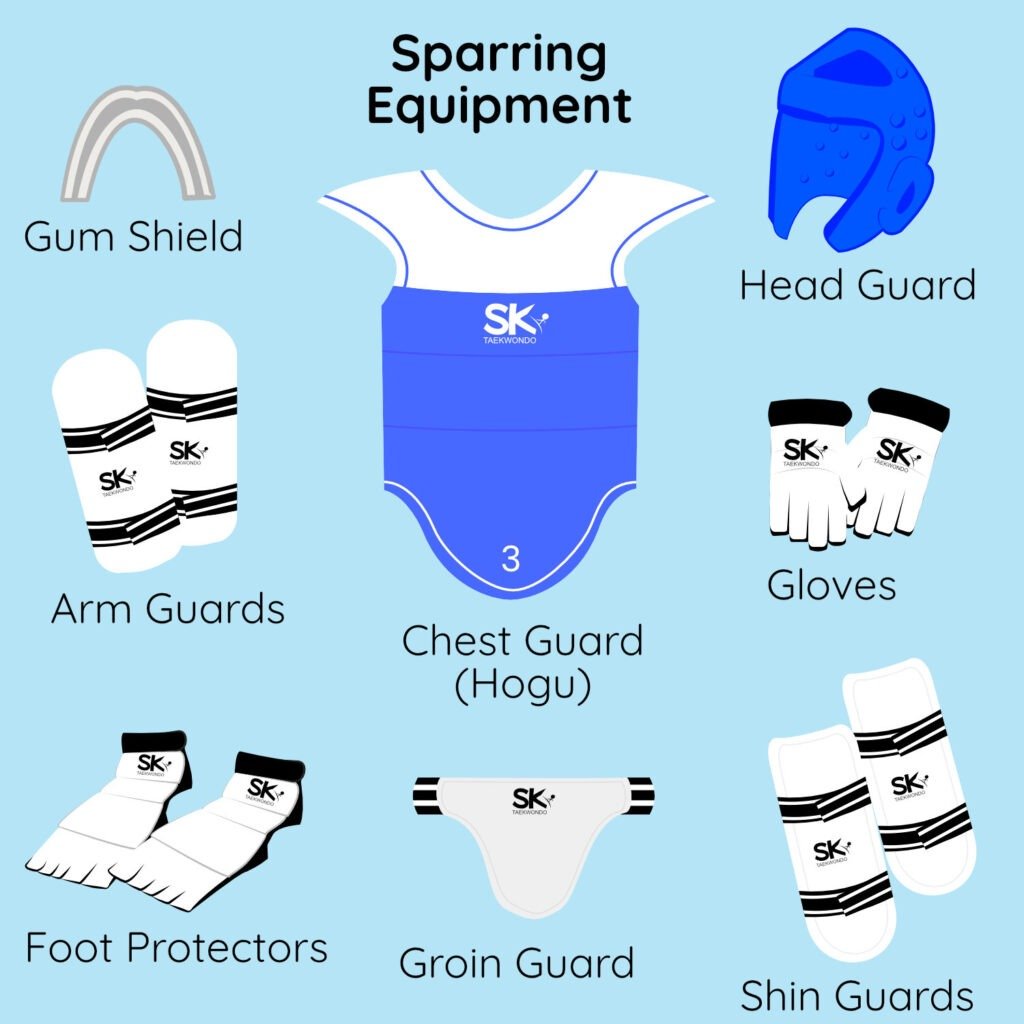
Clubs will have their own requirements for in-club sparring and it is common for them to supply Chest Protectors and Head Guards. In competition, this equipment is usually required by the govening body
Head Guard
Usually made of foam material, this protects your head during sparring and fastens securely under the chin. These are usually white but can be coloured red or blue to match the chest guard you are wearing.
Gloves
Gloves aren’t always required during sparring but they can offer some protection to your fingers and hands, particularly if you are punching a chest protector. These are also available in a range of sizes.
Shin Guards
These can vary in size and material. Generally, there are foam ones or hard ones available. These are needed to protect your shins in case of a clash. Some shin guards come with a foot protector attached.
TRAINING, SAFETY & BEGINNER TIPS
Why is Sparring Important?
Sparring allows students to apply Taekwondo techniques against a moving opponent in a controlled environment. While patterns develop technique and control, sparring develops timing, reactions, distance management and decision-making under pressure.
Not all sparring is full contact. Many clubs begin with light-contact drills and technical sparring to help students build confidence safely before progressing further.
Sparring can also improve:
- Fitness and stamina
- Speed and agility
- Confidence under pressure
- Reactions and timing
- Tactical thinking
Common Beginner Mistakes
-
Dropping your guardBeginners often lower their hands after attacking, leaving openings for counter attacks. Keep your hands in a closed fist and guarding position.
-
Kicking too hardControl is more important than power during training. Focus on accuracy and technique first to score points.
-
Standing stillGood sparring requires movement, angles and distance control rather than remaining stationary. Maintain a strong, active stance.
-
Watching the feetPractice your stances and movement until they flow. Beginners often look at their feet and take their eyes off their opponent.
Safety in Sparring
- Sparring should always be controlled and supervised by qualified instructors. Beginners are usually introduced to technical sparring gradually before moving into full-contact training.
- Protective equipment, controlled drills and clear rules all help reduce the risk of injury during training and competitions.
- Good sparring is not about hurting your opponent — it is about developing technique, timing and control.
- For beginners, non-contact sparring may begin with one for one kicking, progressing into two kicks each and adding counters. These sparring drills help beginners develop the necessary control for contact sparring.
Frequently Asked Questions
It depends on the club, style and type of training. Many classes use light-contact or technical sparring for beginners, while competition WT sparring is full contact with protective equipment. Often, clubs will have a separate training night for full contact sparring or squad training.
Yes. Beginners are usually introduced through simple drills and controlled sparring exercises before progressing to more advanced sparring.
Yes. Equipment requirements vary between clubs, but gum shields, arm guards, shin guards, chest protectors and head guards are commonly used for full-contact sparring. A lot of clubs will have chest and head guards for students to use in training.
Yes, sparring is usually a grading requirement. However, the sparring used in gradings is usually non-contact or semi-contact for advanced students. Most clubs will not use full contact sport-style sparring in a grading, and will instead focus on technical sparring. Again, this will increase in difficulty as you progress, with beginners doing only controlled sparring.