
Competition Poomsae
Poomsae forms a key part of Taekwondo training and grading, but it can also be performed competitively. Rules and competitions vary between styles and governing bodies, but poomsae competitions are usually available at club, national and international levels. The information on this page will give you an overview of the most common setups and scoring guidelines found in competitive poomsae, but please remember this may not be accurate for your particular style or association. If in doubt, please consult your instructor and the relevant governing body for your association.
Depending on the competition you might choose your own pattern to perform, use the one for your current grade or one of the judges choosing. As well as individual patterns, some competitions will include categories for creative patterns, poomsae with a weapon, or synchronised patterns where you will perform with a partner or small team.
Cut Off System
This format uses preliminary rounds, a semi-final and a final round to decide who has won. Preliminary rounds are only used in competitions with a high number of entries, and the top 50% from each round will progress to the next round. Advancement is based on the highest points scored.
You may be required to perform a different Poomsae in each round.
Elimination
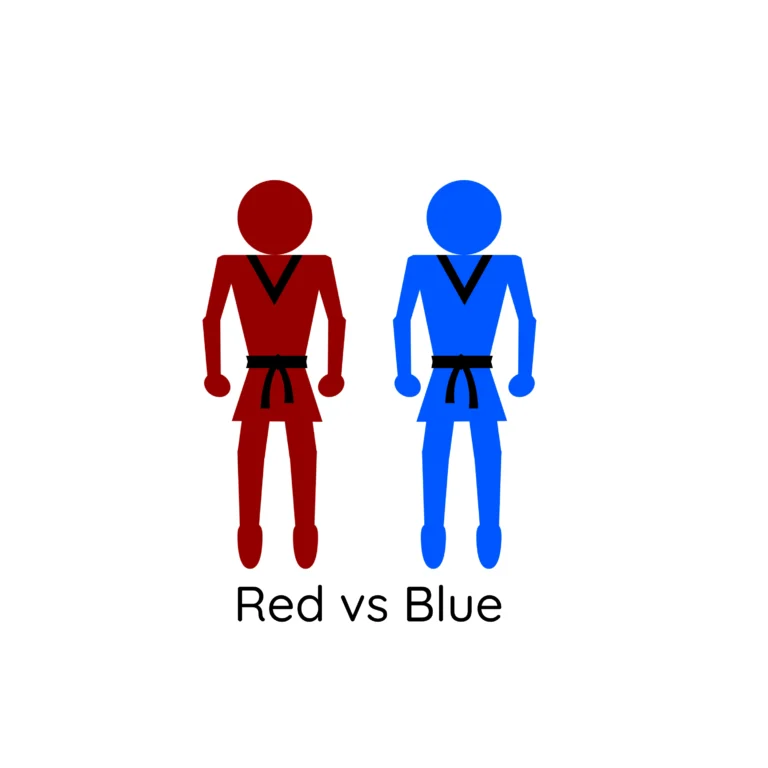
The opponent is decided randomly or by seeding. Two competitors enter the ring with one blue and the other red. Each performs a pattern and judges will decide the winner by voting blue or red. The other competitor is eliminated immediately. The winners will then be randomly matched again until a final is reached.
Poomsae can be chosen by competitors or judges.
Round Robin
Each competitor competes against every other competitor. Two competitors will perform a pattern in each round, similar to elimination competitions. Rounds will continue until all competitors have competed with each other. The overall winner is decided based on the judge’s score.
This competition style is better used when there are fewer competitors due to the number of rounds required.
Scoring in Competition Poomsae
The scoring information given here is to provide basic guidance on how Poomsae is scored in WT-style competitions. Of course, scoring criteria will differ for team Poomsae and Freestyle Poomsae. Generally, Poomsae is scored out of 10, with 4 points being linked to accuracy and 6 points linked to presentation. Points are deducted based on the same criteria of accuracy and presentation.
It’s important to remember judges will expect different standards from different grades. For example, if a higher grade were to perform Taegeuk Il Jang there may be a heavier emphasis on tempo, power and expression than if a student performed Il Jang as their grade pattern.
Ultimately, competition Poomsae requires a combination of technical proficiency and performance skills to be successful. It is equally important to understand the deeper meaning behind each Poomsae and incorporate this into your movements. For example, Keumgang represents Mountain or ‘too strong to be broken’. The movements of this pattern may therefore be bolder and stronger than if you were performing Taegeuk Yuk Jang (Water).
Beyond scoring systems and match formats, successful Competition Poomsae also depends on presentation, rhythm and technical control. Judges will look for certain things when scoring your performance, and there are several common mistakes you should aim to avoid when competing in Poomsae.
What judges look for
In WT Competition Poomsae, judges score more than just remembering the pattern correctly. Competitors are expected to demonstrate strong technique, balance, rhythm and confidence throughout their performance.
At higher levels, judges will also look for:
- Consistent power and speed
- Correct stances and posture
- Controlled breathing and rhythm
- Strong presentation and expression
- Accurate transitions between techniques
A technically correct performance with good control will often score higher than a faster performance with mistakes.
Common Competition Mistakes
Rushing the Pattern: Strong rhythm and control matter more than speed.
Weak Presentation: Confidence, posture and a strong Kiyap all contribute to presentation scores, as well as strong technique.
Losing Balance: Poor balance can weaken technique, leading to deductions. Stable stances and controlled movement are essential.
Incorrect Technique: Mistakes in hand position, stance length, or kick height may reduce accuracy scores, as can missing the Kiyap.
Frequently Asked Questions
Yes. Competitors are expected to perform the pattern from memory. Forgetting movements, pausing for long periods or performing the incorrect pattern may result in deductions or disqualification depending on the competition rules.
Yes. Many local and regional competitions include beginner and coloured belt divisions. Competitors are usually grouped by age and grade, and will only be asked to perform patterns up to their belt grade.
Most competitions require a clean Taekwondo dobok and your grade belt tied properly. Remember, your dobok is part of your overall presentation in poomsae, so keep it tidy.
This will depend on the competition rules and your belt grade. Many club level competitions will allow you to choose a pattern to perform up to the one for your grade, but in competitions with multiple rounds you may be asked to perform a different pattern in each round, or the judges may choose for you. At higher grades you will know more Poomsae and could be asked to perform any you have previously learnt.
